What is nicotine replacement therapy?
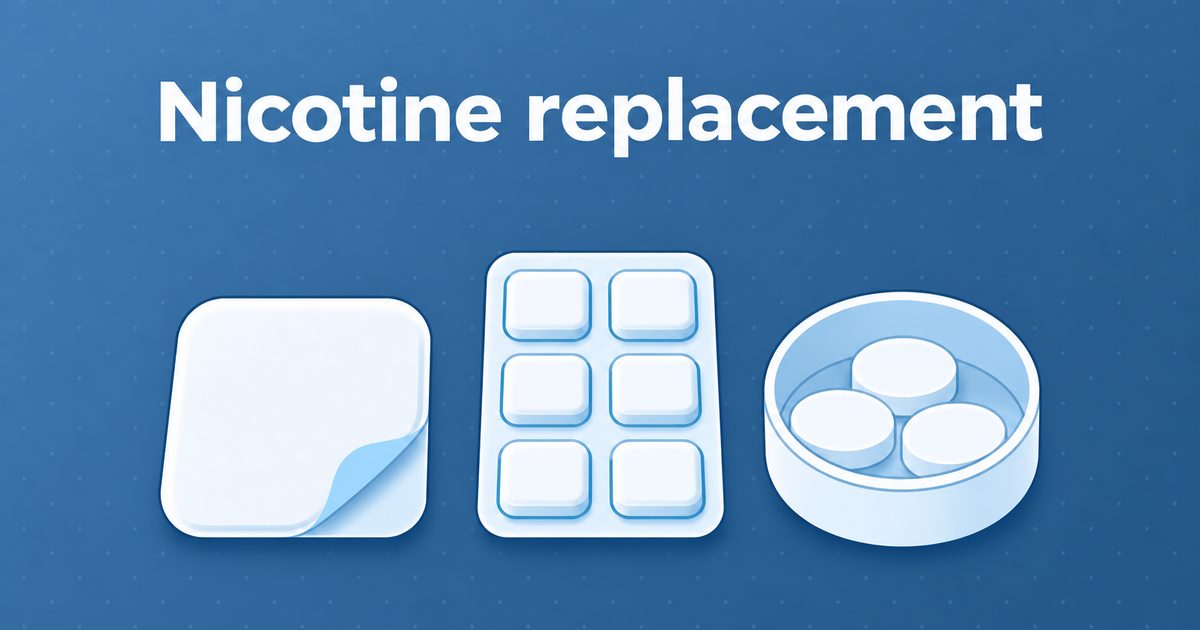
Nicotine replacement therapy (NRT) is nicotine in a form that is not tobacco smoke or vape aerosol. Depending on the form, the nicotine goes in through the skin, the lining of your mouth or your nose, to ease cravings and withdrawal while you stop.
The National Health Service (NHS) in the United Kingdom lists these forms: patches, gum, lozenges, microtabs, inhalators, mouth sprays and nasal sprays. It sorts them into two groups. Patches are slow-acting. The others are fast-acting. The NHS says you can buy NRT in pharmacies, supermarkets and some other shops, and that a general practitioner (GP) or a local stop smoking service may prescribe it.
This post covers what the trials found. For the gum on its own, see does nicotine gum help you quit vaping.
What the evidence says about quitting cigarettes
For cigarettes the evidence is strong. A 2018 Cochrane review of NRT pooled 133 studies with 64,640 people who smoked, and compared any form of NRT with a placebo or no NRT. People using NRT were more likely to quit for the long term (risk ratio 1.55). Cochrane's summary puts it as the chances of stopping smoking being increased by 50% to 60%. The review covered gum, patches, lozenges, inhalators and nasal spray.
A 2023 Cochrane review of 68 studies with 43,327 people looked at how to use NRT. Using a patch together with a fast-acting form gave better long-term quit rates than using one form alone (risk ratio 1.27, 16 studies, 12,169 people, high-certainty evidence).
Those results were measured in people who smoke, and the 2018 review makes no statement about vaping. For how much nicotine a vape can hold, see how much nicotine is in a vape.
What trials show about quitting vaping
The trial evidence for vaping is thin. A Cochrane living review, published in November 2025 with evidence up to 1 July 2025, found 15 studies with 5,800 people who vaped nicotine. Fourteen were in the United States and one in Italy. It reached these conclusions:
- Combination NRT, cytisine and gradual nicotine reduction: the authors call the evidence inconclusive because of risk of bias and imprecision.
- Varenicline, a prescription medicine that is not a form of NRT: low-certainty evidence that it may help people stop vaping.
- Text messages for young people aged 13 to 24: low-certainty evidence that they may help more people stop than no support or minimal support.
- Harms: most studies that measured serious side effects reported none, but there was not enough information to draw conclusions.
A 2026 review of vaping cessation trials by Zolotarova and colleagues found three NRT trials, with 567 participants in total, and none showed that NRT worked better than the comparison group once treatment ended. Those three trials:
- Vickerman and colleagues (2025): 508 United States adults aged 18 to 24 who vaped regularly and wanted to quit all received coaching calls. Some were also mailed NRT for 8 weeks. At 3 months, 48% of those mailed NRT said they had not vaped in the past 7 days, against 41% and 43% in the two groups not mailed NRT. The difference could not be separated from chance (odds ratio 1.3, 95% confidence interval 0.91 to 1.84). The authors say quit rates were higher than they expected, which reduced the trial's power to detect differences, and call for a larger trial.
- Two pilot trials: one of 30 people and one of fewer than 30 people compared NRT with other approaches. Neither found a clear difference.
For context, two trials have tested varenicline, which is not nicotine replacement but a prescription-only medicine. In both, people also had counselling. In 140 adults in Italy (Caponnetto and colleagues, 2023), 40% on varenicline against 20% on placebo had not vaped at all from weeks 4 to 12. In 261 people aged 16 to 25 in the United States (Evins and colleagues, 2025), 51% against 14% had not vaped from weeks 9 to 12, and 28% against 7% from weeks 9 to 24. Whether varenicline is suitable for anyone is a decision for a doctor who knows their health. It is not sold over the counter, and this post gives no guidance on taking it.
So the trials so far leave the question open. NRT may help someone who vapes, but the trials to date have not shown that it does, and they cannot tell you which form works best. The harms data is too thin to say much either way.
What the NHS, the CDC and Smokefree.gov say
- NHS: its guidance on quitting vaping describes NRT as an option for people who want to stop in one step instead of cutting down slowly. It says a suitable NRT product may help with withdrawal, and tells you to ask a pharmacist or a stop smoking adviser. The page does not cite trial figures for vaping.
- Centers for Disease Control and Prevention (CDC): its 2024 page on vaping and quitting says the FDA has not approved any e-cigarette to help people quit smoking. It says a health care provider may suggest medicines to help with withdrawal and cravings, and points to the 1-800-784-8669 quitline for confidential coaching at no cost. It does not name NRT.
- Smokefree.gov: this National Cancer Institute site says NRT, varenicline and bupropion are used to help people quit cigarettes and can ease cravings. It states that the FDA has not approved these medicines to help people quit vaping, and suggests asking a doctor or another health care professional for help.
In the United Kingdom, the product information for one nicotine mouth spray, Nicorette QuickMist Spearmint 1mg, says it relieves craving and withdrawal in nicotine dependence, such as that arising from the use of tobacco or electronic cigarettes. That is one product, and it is not a statement that the other forms have been shown to work for vaping.
How to decide, step by step
- Get a number. A pharmacist or adviser can only match a product to your vaping if they know how much you vape. A week of counted puffs is a firmer start than a guess.
- Ask a pharmacist or stop smoking service. Say you vape, not smoke, and ask what they suggest and why. In the United Kingdom, stop smoking services are free. In the United States, you can call 1-800-784-8669.
- Plan for the cravings either way. NRT is one tool. Cravings still arrive, and the guide to dealing with nicotine withdrawal covers what to do in the moment.
- Check in after a few weeks. If a product is not helping, or causes side effects, go back to the person who suggested it rather than stopping alone.
If you want the wider picture first, start at quit vaping.
Common questions
Do nicotine patches help you quit vaping?
Patches are one of the NRT forms shown to help people quit cigarettes. For vaping, the Cochrane review calls the evidence on combination NRT inconclusive, and the largest trial of mailed NRT, with 508 young adults, could not separate its result from chance. The NHS lists patches among the NRT options and suggests asking a pharmacist whether one suits you.
Is NRT approved to quit vaping?
It depends on where you live. In the United States, the FDA has not approved NRT, varenicline or bupropion to help people quit vaping, according to Smokefree.gov. In the United Kingdom, the product information for one nicotine mouth spray lists dependence from e-cigarette use among its uses.
What do the trials say about side effects of NRT for vaping?
The Cochrane vaping review says most studies that measured serious side effects reported none, but there was not enough information to draw conclusions about harms. A pharmacist or doctor can advise on your situation, including any health condition or medicine you take.
What if NRT does not work for me?
The Cochrane vaping review found low-certainty evidence for two other approaches: text-message support for young people aged 13 to 24, and varenicline, a prescription medicine. Only a doctor can say whether varenicline is suitable for you. A coach on a quitline such as 1-800-784-8669 can help you adjust your plan.