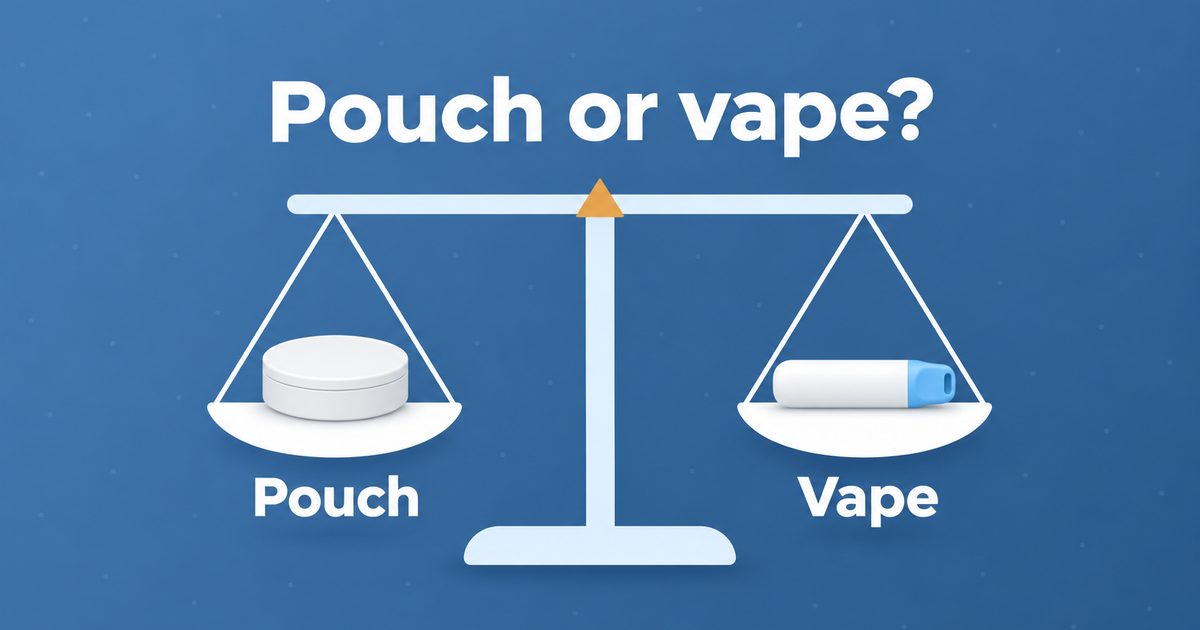
Nobody can say yet that nicotine pouches are better than vaping, or the other way round. The two products carry different risks, and the research that would compare them directly is thin. What can be said is that both deliver nicotine, and nicotine is the part that keeps people using them.
If you are asking because you want to stop vaping, the short version is that pouches are not a tested way to do it. The longer version is below.
What each one delivers
A nicotine pouch is a small pouch of nicotine powder, flavouring and fillers that you hold between your lip and gum. It contains no tobacco leaf. Nicotine passes through the lining of the mouth. Zyn is sold in the US in 3 mg and 6 mg strengths for the products the Food and Drug Administration (FDA) has authorised.
A vape heats a liquid into an aerosol that you breathe into your lungs. The liquid holds nicotine, flavouring and a base liquid. How much nicotine reaches you depends on the liquid strength, the device and how you puff. See how much nicotine is in a vape for the amounts.
| Nicotine pouch | Vape | |
|---|---|---|
| How it enters the body | Through the lining of the mouth | Inhaled into the lungs |
| What else you take in | Flavourings and fillers held against the gum | An aerosol: see the list below |
| Speed | Slower rise in blood nicotine than a cigarette | Not measured in the pouch studies below |
| Dependence | Nicotine can sustain it | Nicotine can sustain it |
A 2025 systematic review of seven trials by Heshmati and colleagues compared pouches with cigarettes and moist snuff. In a meta-analysis of three of those trials, 4 mg pouches delivered about 92% of the total nicotine a cigarette does, but with a lower peak. Blood nicotine peaked 5 to 8 minutes after a cigarette and 20 to 65 minutes after a pouch. The studies compared pouches with cigarettes, not with vapes, so they do not tell you how a pouch compares with your vape.
What is known about harm
Vapes
The Centers for Disease Control and Prevention (CDC) says vape aerosol can contain nicotine, cancer-causing chemicals, heavy metals such as nickel, tin and lead, tiny particles that reach deep into the lungs, and volatile organic compounds. The CDC also says scientists are still learning about the immediate and long-term effects. That is a statement of uncertainty, not a finding of safety.
Pouches
Pouches produce no aerosol, so the lung exposures above do not apply in the same way. That is a difference in route, and it is not a finding that pouches are harmless.
The evidence on pouches is short and small. A 2024 systematic review in BMC Oral Health found only three studies, with 190 participants and a high risk of bias in all three. The review describes changes to the lining of the mouth where the pouch sits as common, ranging from slight wrinkling to white patches. Others reported dry mouth, soreness and gum blisters. The authors said research on oral health is limited. That review looked only at the mouth, so it does not tell you about outcomes such as cancer or heart disease.
The FDA says the same about its own decision: authorisation "does not mean these tobacco products are safe", and there is "no safe tobacco product."
What the rules say
United States. On 16 January 2025 the FDA authorised 20 Zyn products (ten flavours, each in 3 mg and 6 mg) for sale to adults aged 21 and over. It found that the pouches contain much lower levels of harmful chemicals than cigarettes and most smokeless tobacco, and judged that the benefit to adults who smoke or use smokeless tobacco outweighed the risks, including the risks to young people. The authorisation covers only those products, not other pouches. On 30 June 2026 the FDA also allowed the claim that using Zyn instead of cigarettes puts a person at lower risk of mouth cancer, heart disease, lung cancer, stroke, emphysema and chronic bronchitis. The same announcement says that fully quitting all tobacco products would most benefit the health of adults who smoke. Both decisions compare pouches with cigarettes. Neither compares them with vaping, and neither says Zyn helps anyone quit.
United Kingdom. Guidance from the Department of Health and Social Care says that from 29 October 2026 it is an offence to sell nicotine pouches, like other vaping and nicotine products, to anyone under 18. From the same date, giving pouches away free to the public, or selling them at a token price such as 10p, to promote them is also an offence. This guidance sets sales rules. It does not say pouches are safe, and it does not describe them as a stop-smoking product.
Do pouches help you quit vaping?
There is no evidence that they do, because the trials so far have tested pouches only in people who smoke.
The licensed products are a separate question, covered in what the evidence shows on nicotine replacement for vaping.
In October 2025, Cochrane published a review of oral nicotine pouches by Hartmann-Boyce and colleagues. It included four small trials with 284 people in total, all of them people who smoked cigarettes. Three of the four trials were at high risk of bias. Pouches might slightly raise the number who quit smoking compared with no help, but the evidence was very uncertain, and the confidence interval included no difference. One small study suggested pouches may be less effective than vapes for quitting smoking. The authors found no evidence on pouches for stopping other products, which includes vaping.
A second 2025 review, in the journal Addiction, covered seven trials with 269 adults. None showed a statistically significant rise in smoking cessation with pouches compared with a control, snus (a Swedish oral tobacco product) or nicotine gum. Adverse events were mostly mild, such as cough, throat irritation and headache.
So the trials say little even about cigarettes, and the Cochrane review found no trial at all of pouches as a way off vaping.
If you already use pouches and want to stop those too, how to quit nicotine pouches covers the withdrawal and the two ways to stop.
The risk of swapping one habit for another
A pouch can satisfy a craving, which is the reason people reach for one. It can also keep the loop going. You still feel the urge, you still reach for nicotine, and the only thing that changed is the product. The Heshmati meta-analysis raised this concern: a 4 mg pouch gives about the same total nicotine as a cigarette, and the authors point to dependence as a risk, especially for people who start using pouches for fun.
If your aim is to stop using nicotine, a switch from a vape to a pouch moves you sideways. If your aim is to stop inhaling an aerosol, it may move you somewhere different, with its own unknowns. Both are fair aims. They are different aims, and it helps to know which one you have.
If you want to cut down or stop
There is no tested pouch route out of vaping, but there are other things to read:
- Does nicotine gum help quit vaping? covers the licensed nicotine replacement products and what the trials on vaping found.
- Quitting vaping: the full guide sets out the options.
- The quitting timeline shows what the first days and weeks feel like.
Common questions
Are Zyn better than vaping?
The evidence does not say. Zyn avoids inhaling an aerosol, and the FDA found the pouches carry lower levels of harmful chemicals than cigarettes. Both FDA decisions compare Zyn with cigarettes, not with vaping. Both contain nicotine, so both can sustain dependence.
Is a nicotine pouch as addictive as a vape?
Both contain nicotine, the substance that drives dependence. In the Heshmati meta-analysis, 4 mg pouches delivered about 92% of a cigarette's total nicotine, with a slower and lower peak. That analysis did not compare pouches with vapes, so it cannot say which is more habit-forming.
Can I use nicotine pouches to quit vaping?
There is no evidence that it works. The 2025 Cochrane review of pouches found no evidence for stopping products other than cigarettes, and its smoking trials were small and uncertain. A doctor, pharmacist or stop-smoking service can tell you about products that have been tested for quitting.
Has the FDA approved Zyn?
No. The FDA authorised 20 Zyn products in January 2025 after a review of their risks and benefits to the population, and says authorisation does not mean the products are safe or FDA approved. In June 2026 it authorised a claim comparing Zyn with cigarettes.
Are nicotine pouches legal in the UK?
The UK government's guidance for sellers sets an age limit: from 29 October 2026 it is an offence to sell nicotine pouches to anyone under 18. From the same date, free giveaways and token-price sales meant to promote them are also offences.