If you are struggling right now
If you feel unsafe, or you are thinking about harming yourself, contact your local emergency services or a crisis line now. In the United States, you can call or text 988 to reach the 988 Suicide & Crisis Lifeline, which is free, confidential and open around the clock. In the United Kingdom and Ireland, you can call Samaritans on 116 123, which is free from landlines and mobiles, day or night.
Why quitting nicotine can bring anxiety and low mood
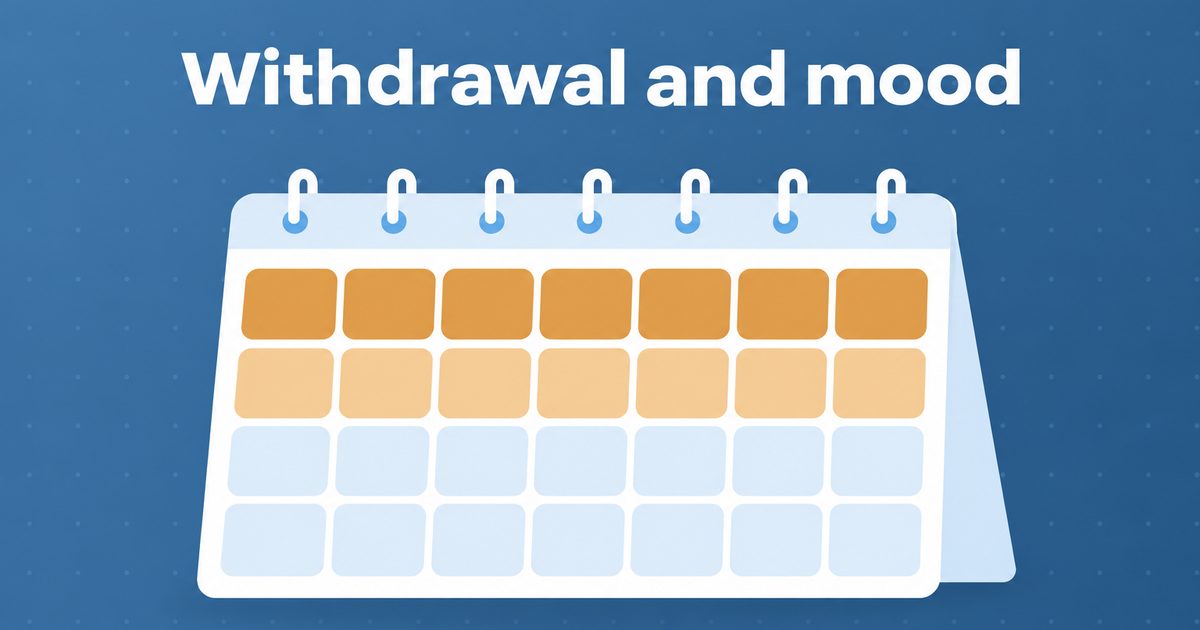
Anxiety, depressed mood and trouble concentrating are not signs that you are doing something wrong. A 2007 review by the researcher John Hughes, published in the journal Nicotine & Tobacco Research, looked at 120 studies of people who stopped using tobacco. It named anger, anxiety, depression, difficulty concentrating, impatience, insomnia and restlessness as valid withdrawal symptoms. In those studies the symptoms peaked within the first week and lasted 2 to 4 weeks.
Two things are worth knowing about that review. First, it covers tobacco, mostly cigarettes, not vaping. Second, the author states that the data collection and interpretation were based on his own judgement, so treat "2 to 4 weeks" as a range from one reviewer, not a promise.
Vaping has its own evidence. In a 2020 clinical trial, 109 former cigarette smokers who vaped every day were asked to go 6 days without their e-cigarette, with abstinence checked by breath and cotinine tests. All the tobacco withdrawal symptoms listed in the fifth edition of the Diagnostic and Statistical Manual of Mental Disorders (DSM-5) increased during those days, and so did four possible new symptoms the team measured: less enjoyment of pleasant things, impulsivity, mood swings and a less positive outlook. The researchers described the withdrawal as only somewhat milder than the withdrawal they had measured in an earlier study of cigarette smokers.
For a symptom-by-symptom list and timeline, see vaping withdrawal symptoms. For how long the urge itself lasts, see how long nicotine cravings last.
"Brain fog" and poor concentration
Difficulty concentrating is on the 2007 review's list of valid withdrawal symptoms, so a foggy, easily distracted feeling after quitting is a recognised part of withdrawal. The same review found it fades within the same 2 to 4 weeks as the other symptoms, in the smoking studies it covered.
What happens to mood after the first weeks
Withdrawal is the short part. The longer-term question is whether mood ends up better or worse than before. Two large reviews looked at exactly that, and both studied people who quit cigarettes.
- A 2014 review in the British Medical Journal (BMJ) (Taylor and colleagues) pooled 26 studies. Follow-up ranged from 7 weeks to 9 years. Compared with people who kept smoking, people who quit showed larger drops in anxiety, depression, mixed anxiety and depression, and stress, and larger gains in positive mood and psychological quality of life. The authors found no evidence that the effect differed between the general population and people with physical or psychiatric conditions.
- A 2021 Cochrane review (Taylor and colleagues, an update of the BMJ review) pooled 102 studies with over 169,500 participants. Quitting was associated with lower anxiety, depression, mixed anxiety and depression, and stress symptoms, and with higher positive mood. The authors concluded that mental health does not worsen as a result of quitting smoking.
These studies watched people over time; they did not randomly assign people to quit. People who manage to quit may differ from people who do not in ways that also affect mood. The Cochrane authors rated every study as being at serious risk of bias from this problem, and rated their certainty as low for anxiety, very low for depression and moderate for mixed anxiety and depression. Their summary was "small to moderate improvements", not a guarantee.
For vaping, one 2025 study in the journal Tobacco Control used a United States national survey (the Population Assessment of Tobacco and Health study). It followed 912 adults who only vaped, over about two years. Those who quit vaping reported larger improvements in quality of life and mental health than those who kept vaping. That held for people who started the study with high or moderate levels of mental health problems as well as for those with low levels. It is also observational, so it shows an association and does not prove that quitting caused the change.
Does vaping relieve stress?
Many people who smoke believe smoking helps them cope with stress: the authors of the 2010 study below say so, and the 2021 Cochrane review describes the same perception. The research asks a narrower question: is that calm new relief, or is it the end of a small withdrawal that the last puff started?
A 2010 study in the journal Addiction followed 469 people who smoked cigarettes and were admitted to hospital after a heart attack or heart bypass surgery, then wanted to quit. Before quitting, those who went on to stay off cigarettes for a year and those who went back to smoking rated their stress and their belief that smoking helped them cope about the same. After one year, the 194 who stayed off cigarettes had a larger fall in perceived stress than those who kept smoking. The authors concluded that, whatever the immediate effect of smoking on stress, overall it may create or worsen negative emotional states.
The 2021 Cochrane review gives the idea behind this. The reviewers explain that long-term smoking may change the brain in ways that bring frequent withdrawal symptoms, including anxiety, depression and irritability. If so, the relief of a puff can be partly the end of a symptom the previous puff left behind. The reviewers called this "biologically plausible", which means it is a hypothesis, not a finding.
What the research cannot tell you is how much of your own calm after a puff is relief and how much is something more. Both can be true at once.
What can help in the meantime
None of this is a treatment plan, and the right support depends on you. Three steps that do not involve medicines:
- Tell someone. A friend, partner or family member who knows you are quitting can notice when you are having a bad day.
- Ask for support. A doctor, a pharmacist or a stop-smoking or quit-vaping service can discuss options with you, including whether nicotine replacement or other support suits you. Ask them for your own plan; do not rely on a number from a web page.
- Watch the trend, not the worst hour. Counting puffs makes the pattern visible. If your puffs cluster at certain times of day, you can see when the urge tends to come and plan for those hours.
If low mood or anxiety does not ease, gets worse, or stops you doing normal daily things, speak to a doctor. Do not wait for a time range to pass if you are struggling.
More on getting through it: how to deal with nicotine withdrawal.
Common questions
How long does nicotine withdrawal anxiety last?
In a 2007 review of 120 studies of people who stopped using tobacco, anxiety peaked within the first week and lasted 2 to 4 weeks. Those studies were mostly about cigarettes. In the vaping trial, the same set of symptoms rose when people stopped, but the trial lasted 6 days, so it says little about the end point.
Can nicotine withdrawal cause depression?
Depressed mood is listed as a valid nicotine withdrawal symptom in the 2007 review. Low mood during withdrawal is different from a lasting mental health condition. In the 2021 Cochrane review, people who quit smoking reported lower depression symptoms than people who kept smoking, but the authors rated that certainty as very low. If your mood is low for more than a few weeks, or you feel hopeless, talk to a doctor.
Will quitting vaping make my anxiety worse for good?
The evidence points the other way. Neither the 2014 BMJ review nor the 2021 Cochrane review found that mental health got worse in people who quit smoking, and a 2025 study of 912 adults in the United States who vaped found better mental health after quitting than in those who kept vaping. These studies describe groups of people, not what will happen to you, and they cannot prove that quitting was the cause.
Is nicotine withdrawal brain fog real?
Difficulty concentrating is a recognised nicotine withdrawal symptom in the 2007 review, and in the smoking studies it covered it eased within the same 2 to 4 weeks as the other symptoms.
When should I get help instead of waiting it out?
Get help straight away if you feel unsafe or are thinking about harming yourself: contact your local emergency services or a crisis line such as 988 in the United States or Samaritans on 116 123 in the United Kingdom. Speak to a doctor if symptoms do not ease, get worse, or interfere with work, sleep or relationships.